A standard drywall partition does not support the same weight as a load-bearing wall, but some anchoring systems allow you to exceed the limits set by manufacturers. Traditional expansion plugs give way well before the board breaks, except in cases of persistent moisture or if the installation deviates from best practices.
Everything hinges on the choice of framework, metal or wood, the location of the studs, not to mention any reinforced tracks. The final strength really depends on these parameters. Between insurance requirements and manufacturer advice, caution dictates a complete check: knowing the type of partition, distributing loads properly, and anticipating structural weaknesses is what limits breakage.
Plasterboard and wall cabinets: what you need to know before getting started
The identification step is essential if you want a reliable wall cabinet mounting on plasterboard. The BA13 displays its regulatory 13 mm, but not all partitions offer the same resistance: moisture-resistant boards for wet areas, reinforced linings, or classic structures, each has its limits. It is the structure hidden behind the board that makes the difference, not just the thickness. The way to distribute the mass is equally important: plan for multiple anchoring points across the width, rather than risking a single point that fatigues the material.
As for metal studs or partitions with wooden reinforcements, they make all the difference. Often invisible to the naked eye, they form the framework on which the reliability of your installation rests. Using a stud finder, or simply a careful examination of the wall, allows you to place the fixings in the right spot. On a load-bearing wall, you have more freedom, but plasterboard does not forgive improvisation, especially in a kitchen where wall-mounted cabinets endure numerous jolts with each door opening.
The static load, the weight of the cabinet when filled or empty, adds to the dynamic load: repeated handling, moved dishes, swinging doors… Everything is put to the test daily; there is no room for approximation in the choice of fixings.
What tools and fixings to choose for a solid and durable installation?
A secure fixing starts with selecting the right accessories. Plugs, screws, tools: every detail counts to ensure long-term support. Depending on the configuration, prioritize these proven solutions:
- Molly Plug: the reference for plasterboard, to be installed with the expansion pliers.
- MZK Plug or NP Plug: ideal for reinforced or double partitions, they grip better and limit the risk of pull-out.
- Toggle Bolt: suitable for hollow walls, it deploys a tab behind the plasterboard for superior hold.
- Self-drilling Plug: practical for light loads and quick installation.
- Duopower Plugs: versatile, they hold effectively on mixed structures.
- Chemical Anchoring and Threaded Rod: reserved for very heavy furniture, for impeccable anchoring in the support.
For a flawless result, certain tools are essential: a stud finder for accurate targeting, expansion pliers for installing the Molly plugs, a suitable drill, and self-drilling screws if the internal structure is metal or reinforced with wooden battens. In areas exposed to moisture, consider an anti-corrosion plate or screws: the fixings will stand the test of time.
This attention to fixing is not superfluous: it is the assurance of a safe, stable wall cabinet without unpleasant surprises in daily use.

Key steps to securely mount a wall cabinet on a plasterboard partition
Installing a wall cabinet on a plasterboard partition requires method and precision, from the first marking to the last screw tightening. Choose rigor and accuracy; the difference is measured in longevity.
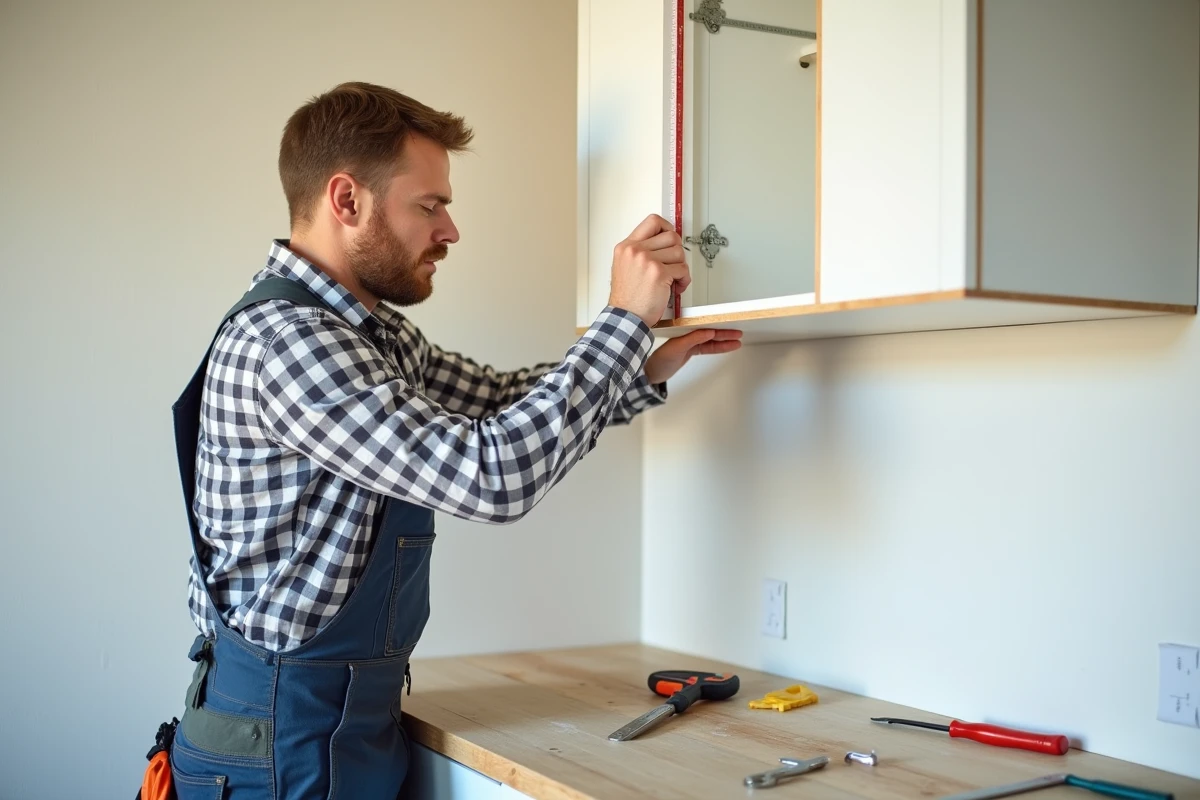
First, mark the location of the cabinet on the wall, carefully aligning the height with the countertop. A spirit level will help you stay straight. Before drilling, use a detector to locate the metal studs or wooden reinforcements; whenever possible, prioritize these anchoring points. The assembly should not be improvised on the BA13.
Next, adapt the fixing: Molly plug on standard plasterboard, direct fixing into the reinforcement if you find it. Drill methodically, insert the plugs, then use the appropriate pliers for optimal expansion. For long cabinets, opt for a suspension rail: it distributes the forces across the entire width and prevents deformation of the support.
Finally, hang the cabinet, tighten each screw gradually, then check for level and horizontal alignment; this is where the detail matters. A professional will then finish the joints with joint compound if necessary, to make the installation invisible.
A wall cabinet correctly installed on a plasterboard partition does more than just hold: it reassures, supports daily life, and allows comfort to settle in without fearing failure at the least opportune moment.