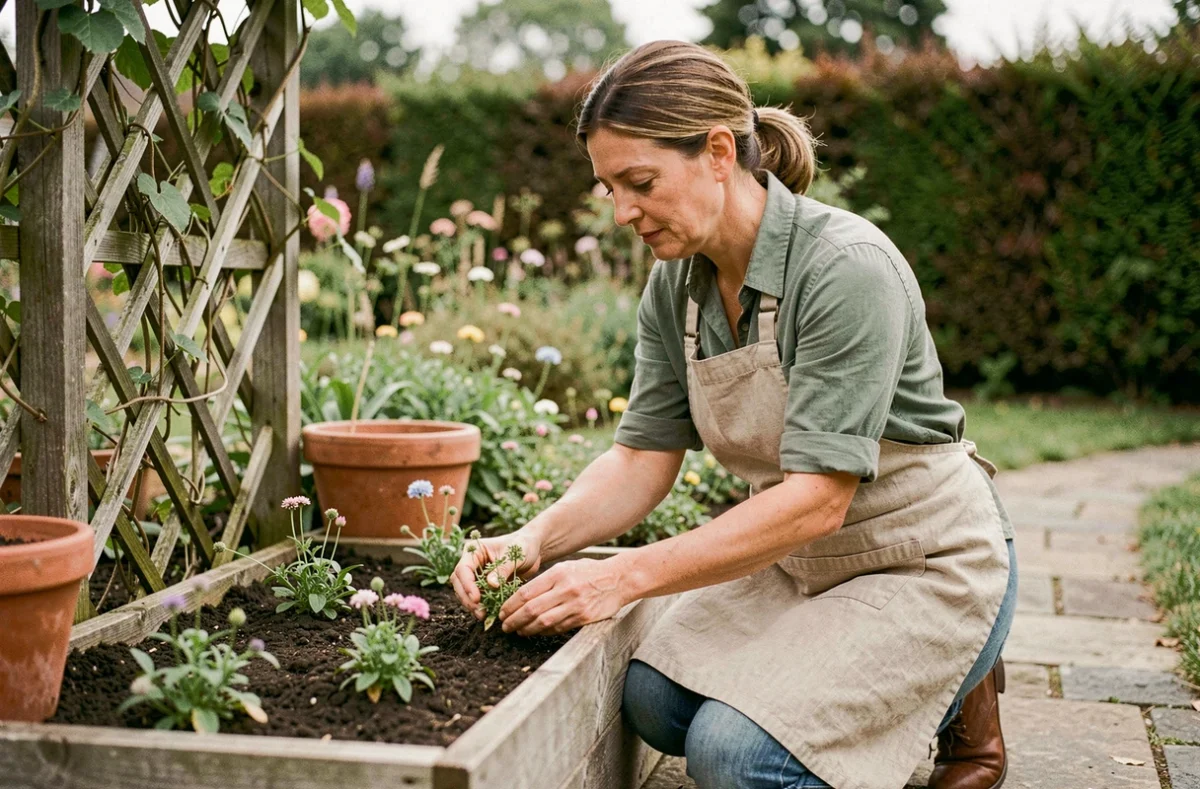
A garden that remains appealing and easy to read twelve months a year depends less on the number of varieties planted than on how their cycles follow one another. The key to a harmonious garden throughout the seasons lies in combining permanent structure, successive blooms and the management of microhabitats.
Planting layers and the garden’s evergreen framework
A garden’s winter appearance reveals the quality of its design. Without a framework of well-positioned evergreens, the garden looks empty as soon as deciduous plants lose their leaves. We recommend establishing this framework before adding seasonal plantings.
Evergreens (yew, boxwood, osmanthus, eleagnus) do more than provide a green backdrop. They create shapes that guide the eye and define pathways. Positioned as focal points at the corners of flower beds or as low hedges along a path, they maintain the garden’s spatial coherence even under snow.
A common mistake is to plant too many evergreens at the expense of deciduous plants. A garden made up of more than half evergreens loses all seasonal dynamism: the foliage never changes, the textures remain the same and autumn goes unnoticed. The opposite ratio—one-third evergreens, two-thirds deciduous plants and perennials—offers a better balance between stability and renewal.
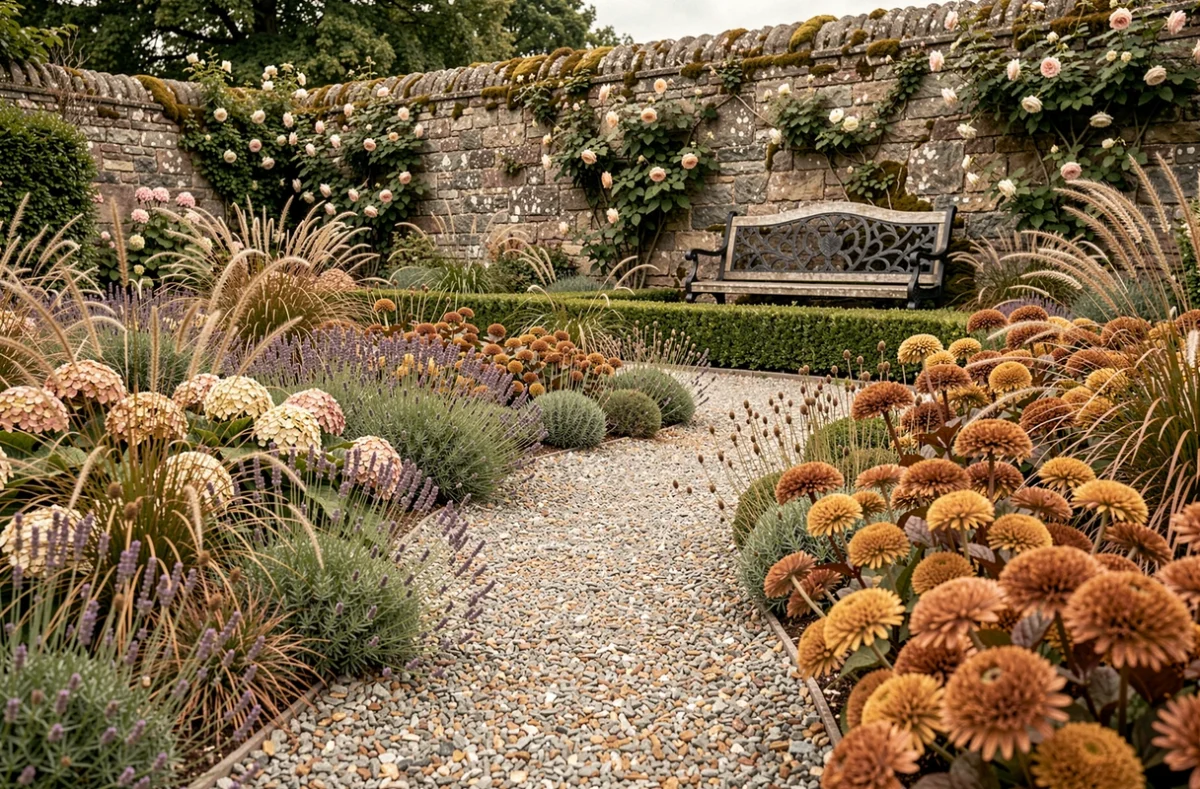
Ornamental grasses play an intermediate role. Their foliage dries in place in autumn and remains decorative until late winter. Miscanthus, pennisetum and stipa add movement and catch the low-angled light, making up for the loss of volume in perennial beds.
Resources such as lesprit-jardin.fr provide details on plant combinations suited to different soil types and exposures, a factor too often overlooked in standardized planting plans.
Succession of blooms and garden color palettes
An inviting garden is about more than a peak flowering period in June. Every month of the year should offer at least one visual focal point, whether flowers, berries, bark or colorful foliage.
Plan a month-by-month succession
The classic pitfall: buying plants in bloom in spring, then ending up with a garden that has nothing to offer from July to March. Planning starts with winter. Witch hazel, hellebores, winter jasmine and colorful-stemmed dogwood keep the garden alive when the rest of it is dormant.
Spring unfolds in two stages. Early bulbs (crocuses, daffodils, grape hyacinths) take over from February in mild regions. Then mid-season perennials (hardy geraniums, nepeta, lady’s mantle) bridge the transition to summer without leaving a gap.
In autumn, asters, Japanese anemones and sedums extend the flowering season. The foliage of deciduous shrubs (winged euonymus, sweetgum, smoke bush) turns coppery or purple, sustaining visual interest until the first frosts.
Colors: keep the palette limited for a more cohesive look
Three dominant colors are enough to make a flower bed easy to read. Beyond that, the eye can no longer establish a hierarchy and the result looks cluttered. Warm colors (orange, red, yellow) appear closer and work well in the foreground. Cool colors (blue, mauve, white) recede and make the view feel deeper.
In a small garden, limiting the palette to two complementary color families (purple and yellow or blue and orange) creates a cleaner effect than mixing every shade available at the garden center.
Tailored garden management: balancing aesthetics and biodiversity
The OFB presents tailored management as a practical way to make gardens more welcoming to wildlife. The principle is simple: not every area of the garden needs the same level of maintenance.
- Paths and living areas (the patio, main lawn and areas around the house) are kept mown and regularly maintained for everyday comfort.
- Borders, the base of hedges and areas out of sight can be cut just two or three times a year, encouraging wild plants and pollinating insects.
- A pile of dead wood or leaves kept in a discreet corner of the garden provides winter shelter for hedgehogs, toads and many invertebrates. A flower bed alone cannot replace these microhabitats.
- A hedge made up of a variety of species (hornbeam, privet, viburnum, elderberry) provides berries over several months, whereas a single-species hedge of thuja provides food for practically no wildlife.
This mosaic approach does not mean leaving the garden untended. It means drawing a clear boundary between well-kept areas and natural areas, which paradoxically makes the garden easier to read by creating deliberate contrast.
Night lighting and living soil: two often-overlooked factors
Even LED or solar lights can disturb nocturnal wildlife. The OFB recommends limiting outdoor lighting by duration, intensity and spectrum. Cool white lights attract more insects than warm lights (amber, below 2,700 K). Directing lights downwards, avoiding permanent lighting and switching them off after a certain time helps preserve nocturnal wildlife corridors.
As for the soil, a harmonious garden throughout the seasons depends directly on what happens beneath the surface. Compacted, depleted soil cannot properly retain water or nutrients. Organic mulch (shredded branches, fallen leaves, straw) protects the soil from summer drying and winter frost while nourishing microbial life.
Soil that is permanently covered needs less watering and less fertilizer than bare soil. Ground-cover plants (pachysandra, vinca, geranium macrorrhizum) complement mulch in shady areas, where organic matter decomposes more slowly.
An inviting garden is not one overflowing with plants, but one where every element (structure, flowering, soil, light) has been designed to work together, season after season. Cohesion always matters more than accumulation.