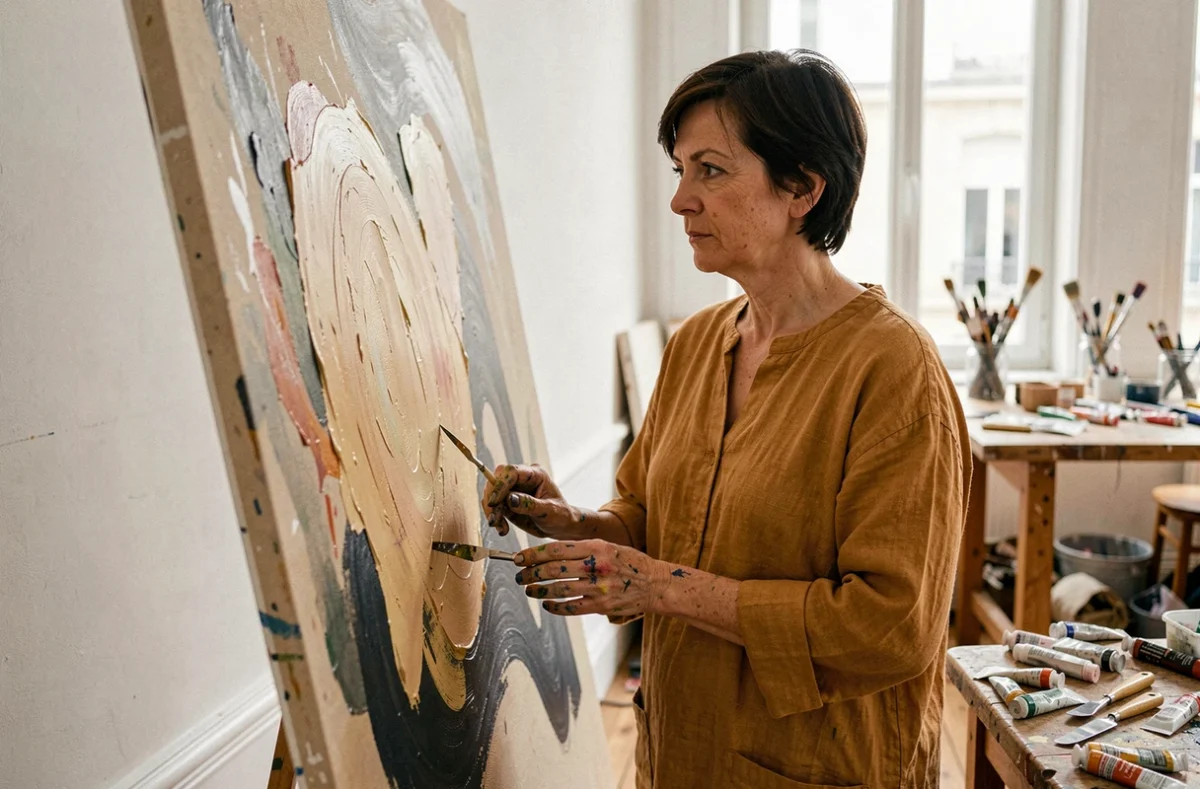
Béatrice Vonderweidt is a figure who moves between two art scenes rarely associated with one another: Paris and Tel Aviv. First known as a model under the name Béatrice Goldnadel, she later turned to painting, producing works whose presence in public archives remains fragmentary.
A page on the Institut français de Tel-Aviv website confirms an exhibition in 2008, but provides no catalogue or list of works to clarify what was shown. This documentary gap raises a practical question: what do we actually know about her paintings?
Béatrice Vonderweidt, artist: two names, two careers to piece together
The first challenge for anyone seeking to document Béatrice Vonderweidt’s work is that she has two public identities. Under the name Goldnadel, she appears in contexts related to modeling and Parisian fashion. Under the name Vonderweidt, she is associated with painting.
This dual identity complicates any search of museum databases or exhibition catalogues. Search engines and institutional portals rarely cross-reference the two names, fragmenting the artist’s visibility.
Looking at the paintings of Béatrice Vonderweidt, the artist through the online sources available, we see the gap between the figure’s renown and the information accessible about her work. Several web pages mention paintings, describe a style, and refer to exhibitions, but verifiable details—precise dates, venues, and artwork titles—remain scarce.
Searching under both names is essential for anyone trying to reconstruct her full career. Without this dual approach, a significant part of her artistic activity is missed.
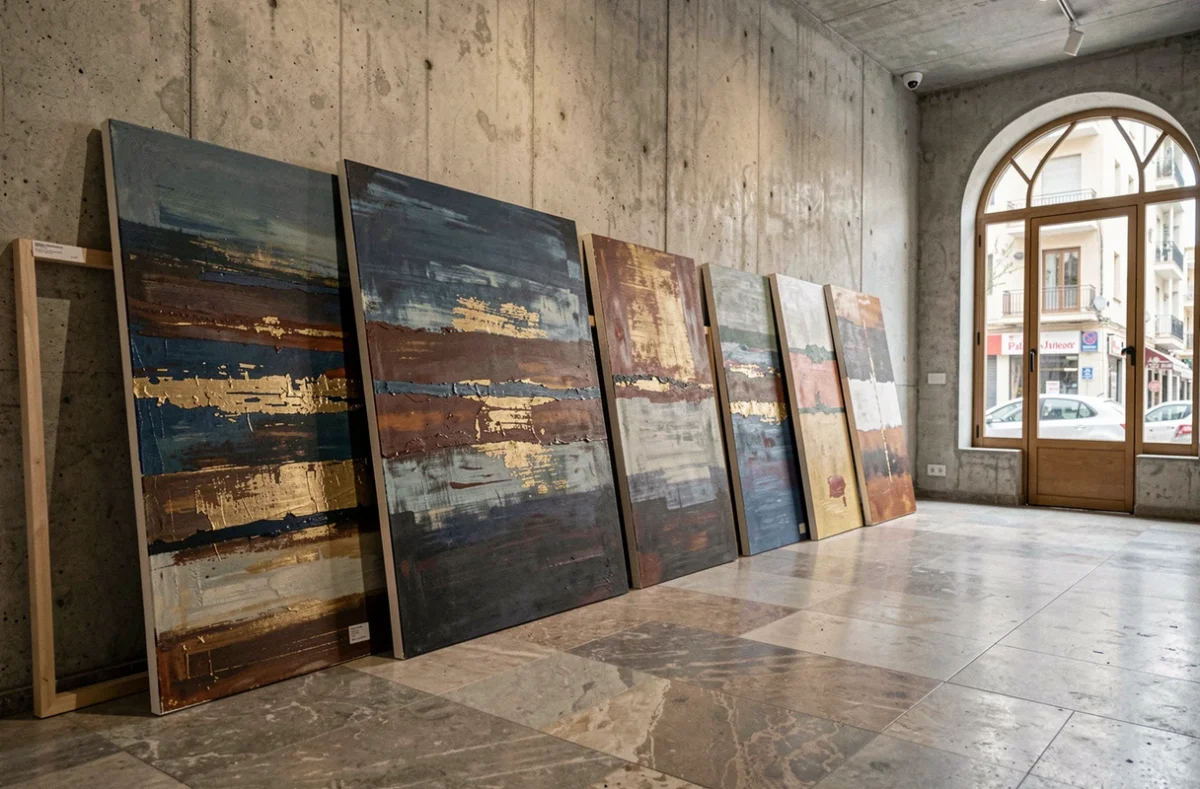
Exhibitions between Paris and Tel Aviv: what the archives can confirm
The Paris–Tel Aviv axis shapes the story of Béatrice Vonderweidt. Paris represents her roots in the worlds of fashion and decorative arts. Tel Aviv is where her artistic practice is said to have developed or been exhibited.
On the Paris side, online sources link the artist to circles close to contemporary design and fashion, but no museum or institutional gallery has been clearly identified as a permanent venue for her paintings. Paris’s dense, ever-changing gallery scene makes this kind of verification particularly difficult for artists who exhibit outside the most widely publicized circuits.
The documentary record in Tel Aviv
In Israel, the reference to an exhibition at the Institut français de Tel-Aviv in 2008 is the only verifiable institutional point of reference to date. The available sources do not specify how many paintings were shown, their titles, or the circumstances of the exhibition.
The lack of a catalogue raises a common methodological problem in contemporary art: without exhibition documentation—an invitation, a curator’s text, or a list of works—it is difficult to distinguish a solo exhibition from a group show, or to confirm the dimensions and techniques of the works on display.
- The Institut français de Tel-Aviv is cited as an exhibition venue in 2008, but no public catalogue has been found in the databases consulted.
- Searches of French media library and museum archive portals have not returned any artwork records indexed under the name Vonderweidt or Goldnadel.
- Several websites describe paintings and a pictorial style, but do not reproduce primary sources such as installation photographs or signed critical texts.
Béatrice Vonderweidt’s painting style: what is said and what is missing
Online descriptions refer to paintings distinguished by their use of color, gestural energy, and references to both figurative and abstract art. Some pages describe work that shifts between portraiture and free composition, shaped by her years in the worlds of fashion and image-making.
Despite their consistency across different sources, these descriptions share one limitation: they are not supported by any critical text signed by an identified art historian or exhibition curator. In contemporary art, validation generally comes through this kind of mediation, whether in a catalogue essay, a review in a specialist journal, or an entry in an institutional database.
This observation says nothing about the quality of the work. It simply indicates that documented critical reception has not yet reached the level of visibility needed to discuss it with the same degree of certainty as the work of better-archived artists.
The question of reproductions
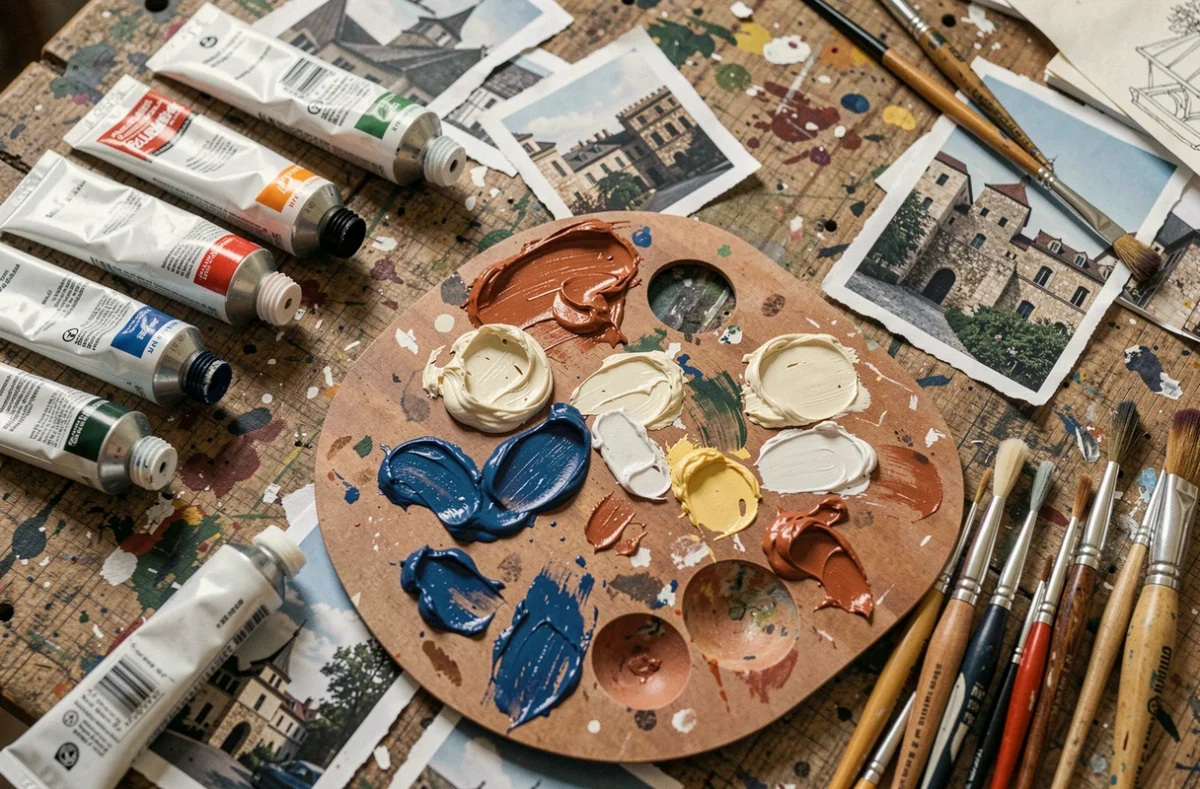
A few reproductions of paintings appear on websites dedicated to the artist. They show a confident use of color and works that seem to range from small to large formats. The lack of complete technical details—dimensions, medium, year of creation, and collection—prevents any serious material analysis.
For a collector or researcher, this gap is a familiar warning sign—not about authenticity, but about the level of professionalism in how the work is presented. An artist whose works are not listed in databases such as those of the Centre Pompidou or the Maison européenne de la photographie is, in practice, outside the French institutional radar.
Contemporary art and traceability: an issue beyond the case of Vonderweidt
Béatrice Vonderweidt’s career illustrates a common situation in the French art market. Many artists create, exhibit, and sell their work without it ever entering public databases. There are several reasons for this:
- Private galleries are not required to report their exhibitions to institutional databases.
- Artists working across several countries see their exhibition histories fragmented across national archival systems that are not interconnected.
- The transition from a career in fashion to one in the visual arts blurs the search categories used by cultural portals.
This lack of traceability does not affect only emerging artists. It also applies to practitioners who have been active for decades, whose work exists physically but not digitally.
The case of Béatrice Vonderweidt is a reminder that online visibility does not reflect the existence of a body of work. Between Paris and Tel Aviv, paintings exist, have been exhibited, and have probably been acquired. Their public documentation, however, remains to be built.