
On a loading dock, a palette that is a few centimeters too wide blocks the truck doors from closing. This type of incident, seemingly trivial, delays an entire delivery route and generates additional transport costs. It quickly becomes clear why the standardization of handling supports conditions the entire logistics chain in Europe.
Rack Load and ISO 8611 Standard: What Has Changed Since 2021
When stacking pallets in shelving, the rack load capacity becomes the critical parameter. Many product sheets still circulate with outdated values, while the operational reality has evolved.
The ISO 8611 standard, revised in 2021, imposes a stricter testing methodology: bending cycles, creep tests, and specific rack protocols. Since 2022-2023, several EPAL manufacturers have lowered their allowable rack load, moving from a commonly cited range of around 1000-1250 kg to a guarantee typically between 750 and 1000 kg, especially for refurbished pallets.
In practical terms, if one is designing a warehouse with accumulation racks, it is essential to consult the updated technical sheets from the supplier (Cabka, LPR, CHEP, or others) and not rely on generic data found online. The dimensions of a Euro pallet remain fixed (1200 x 800 mm, height of 144 mm), but mechanical performance varies depending on the condition of the support and the certification protocol applied.

Euro Pallet 1200 x 800 mm: Anatomy of a Format Designed for Trucks
The 1200 x 800 mm format is not arbitrary. It was designed in the 1950s-1960s by European railway networks (with Sweden and Germany leading) to fit the interior widths of standard wagons and trailers.
Today, a 2.44 m wide interior semi-trailer can be loaded with two Euro pallets side by side (800 + 800 = 1600 mm) or three staggered along the long axis. This direct compatibility with the European road gauge explains why the format has prevailed over alternatives.
Empty Weight and Static Load
An EPAL 1 pallet weighs about 25 to 30 kg when empty, depending on the moisture content of the wood. In static load (pallet placed on the ground, without movement), it supports up to 4000 kg. In dynamic load (transport, stacking), it generally drops to 1000-1400 kg.
These values determine the choice of handling equipment. A standard forklift is suitable, but the fork adjustment must correspond to the three feet of the pallet, spaced according to a standardized distance.
EPAL Marking and NIMP 15 Treatment: Reading a Pallet Before Loading
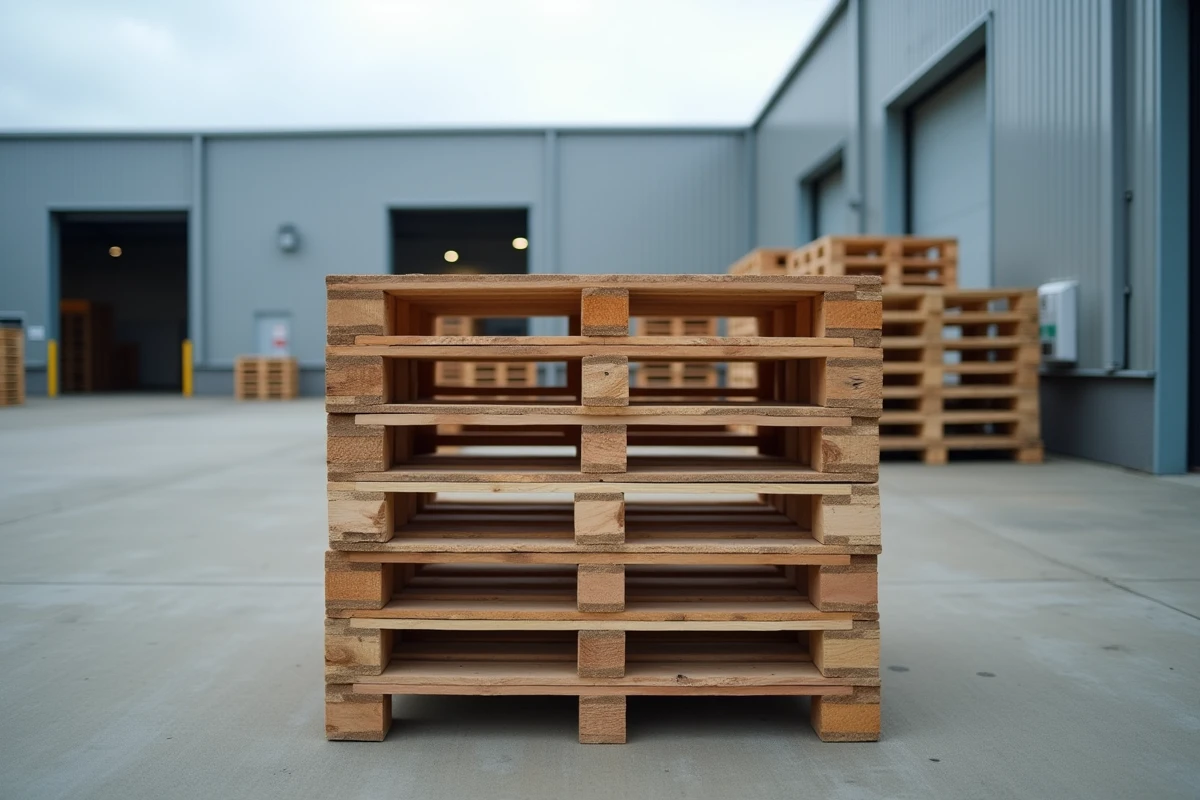
On the ground, a compliant Euro pallet can be identified by several visible elements on the corner blocks:
- The EPAL (European Pallet Association) and/or EUR logo, stamped with a brand or nail
- The IPPC logo with the phytosanitary treatment code (HT for heat treatment, compliant with the NIMP 15 standard)
- The number of the approved manufacturer and the country of production code
The NIMP 15 marking is mandatory for any international transport of wooden pallets. Without this treatment, customs in many countries refuse entry of goods. Entire batches have been blocked at borders because the IPPC stamp was illegible after repair.
The Qualipal certification, specific to France, guarantees that repairs are carried out by approved companies according to a precise specification. A refurbished pallet under the Qualipal label retains its original mechanical properties, provided that the number of replaced boards remains within the allowed limits.
Euro Pallet and Decarbonization of Transport: The Direct Link with the Loading Plan
Classic logistics articles rarely present the 1200 x 800 mm pallet as a lever for reducing emissions. The reasoning is simple: a better truck filling rate means fewer empty trips.
With the Euro format, we optimize the floor space of a standard trailer. A well-thought-out loading plan allows for fitting 33 pallets per semi-trailer in a classic configuration. Alternatives (such as the American pallet 1000 x 1200 mm) leave more lateral wasted space within a European road gauge.
In the context of low emission zones (LEZ) that are becoming widespread in Europe, every eliminated trip counts. The standardization of handling support acts upstream, even before discussing electric motorization or biofuels.
Wood, Plastic, or Cardboard: The Material Changes, Not the Format
The 1200 x 800 mm format also exists in plastic and corrugated cardboard. The choice of material depends on the use:
- Wood remains the standard for multi-rotation (reuse, repair, pooling between companies)
- Plastic is suitable for agri-food or pharmaceutical environments where hygiene requires washable surfaces
- Cardboard, for single use, is used for export when one does not wish to manage the return of supports
Regardless of the material, the outer dimensions remain identical, ensuring compatibility with racks, conveyors, and truck tailgates. This is the strength of a dimension standard shared on a continental scale.
Repair and Lifespan of a Wooden EPAL Pallet
A well-maintained wooden Euro pallet goes through several rotation cycles. Repair, regulated by the EPAL and Qualipal networks in France, significantly extends this lifespan. Split boards or damaged corner blocks are replaced, and then the marking is reapplied.
Returns vary on this point, but most fleet managers estimate that an EPAL pallet can support between five and ten rotations before requiring intervention. After repair, the allowable load may be slightly lower than that of a new pallet, especially in racks, as confirmed by the new ISO 8611:2021 requirements.
This repair-reuse cycle also feeds into the circular economy of the sector. End-of-life wood is shredded to produce particle boards or biomass energy, thus closing the loop without terminal waste.